
July 22 2026
On the eve of the Council of the Federation meeting in Charlottetown, PEI, the National Union of Public and General Employees (NUPGE) held a reception featuring a discussion about AI, Public Services, and the Public Good.
“As governments everywhere weigh AI developments and what they mean for citizens and communities, this is a timely chance to hear directly from researchers working at the forefront of these questions,” said Bert Blundon, NUPGE President.
In commenting on the event, Blundon said: “We were happy to have two Premiers attend, B.C. Premier, David Eby, and New Brunswick Premier Susan Holt, to spend some time with us discussing the challenges our members are facing – cuts to public services, healthcare, and the impact of AI on jobs, and on the future of our communities.”


There is a growing list of harms about the use of AI already known to the public: rapid spread of misinformation, job displacement, bias and discrimination, privacy violations, the devaluation of cognitive skills, and massive environmental costs. There is as well the potential of AI to become a threat to human control and our safety.
In an interview with Global, AI Minister Evan Solomon stated that “AI is going to benefit every Canadian, no matter where you live, no matter what you do, no matter what age you are,” Solomon said.
This is despite overwhelming data showing Canadians are greatly concerned about AI.
An Ipsos’s annual AI Monitor report which surveyed 32 countries on attitudes around AI found Canadians remain among the least-trusting and least-enthusiastic populations when it comes to the technology. The report found the number of Canadians who expressed excitement about AI products and services actually fell five points since last year, to just 26%. It also shows that 14% say AI will improve the country’s economy and 11% say it will improve the job market in the next three to five years.
To delve deeper into the issue, NUPGE invited top researchers to share their findings and insights on the use of AI, how it can affect public services, workers, and communities.
Adrian Harewood, well-known CBC journalist and Carleton University professor, facilitated the conversation with two of today’s leading voices on artificial intelligence, David Scott Krueger and Joanna Redden.
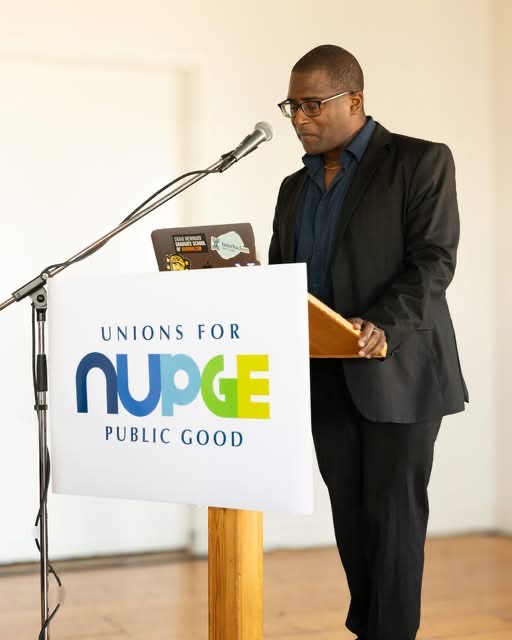


Krueger is an Assistant Professor in Robust, Reasoning and Responsible AI at the Université de Montréal, a Canada CIFAR AI Chair, and a core academic member of Mila – Quebec AI Institute. His research focuses on the safety, governance, and accountability of AI systems,
Redden is an Associate Professor in the Faculty of Information and Media Studies at Western University, where she co-directs the Starling Centre for Just Technologies and Just Societies, and co-directs the UK-based Data Justice Lab. Her work maps how governments use AI and automated decision-making and documents the harms these systems can cause.
Redden argues that public discussion of AI focuses too little on how its effects are unevenly distributed — echoing American political scientist Virginia Eubanks’ point that AI affects everyone, but not equally. Redden has found that once harmed, it’s extremely difficult both to get redress and to then prevent them from recurring.
By way of example, Redden raised the issue of how facial recognition is being used and the terrifying outcomes as in the case of Nijeer Parks in the United States – a black man who was falsely accused of shoplifting and assaulting a police officer in 2019 and subsequently arrested using AI. This same technology is being used by police in the Peel region of Ontario.
She also points out that government agencies rarely study a system’s likely real-world impact before rolling it out, and that in the most serious cases she’s studied, hasty implementation has caused significant human and financial harm.
Both Redden and Krueger call attention to the political and economic interests behind AI deployment, noting a gap between how these technologies are marketed and rapidly rolled out versus how affected communities actually experience and respond to them.
Krueger believes there is much more urgent need for action against AI to reduce even greater risk to humanity. His core worry is about the pace at which companies and governments are deploying AI: he fears we could end up ceding control of major systems to AI entirely — not just economic power, but political and cultural power too — to the point where humans lose the ability to direct the future. If that happens and AI’s goals aren’t aligned with human interests, he warns, we could lose the ability to secure life’s basic necessities.
He proposes a global moratorium on frontier AI development, pausing work on more powerful systems until there’s a clearer understanding of how to manage the risks they pose.
For NUPGE President Bert Blundon, “What we are hearing is a need to address issues of power and control when it comes to AI. The danger isn’t necessarily a single dramatic event, but a slow, compounding process of ceding control, in ways that become progressively harder to reverse the longer it goes unchecked. It falls to us, as labour leaders, to demand proper impact assessments, consultations with affected communities and transparency regarding the costs involved. Citizens and workers must know what powers are being delegated to AI, when reassessments are conducted, what off-ramps there are, and how rollbacks and shutdowns occur.”