
April 2 2026
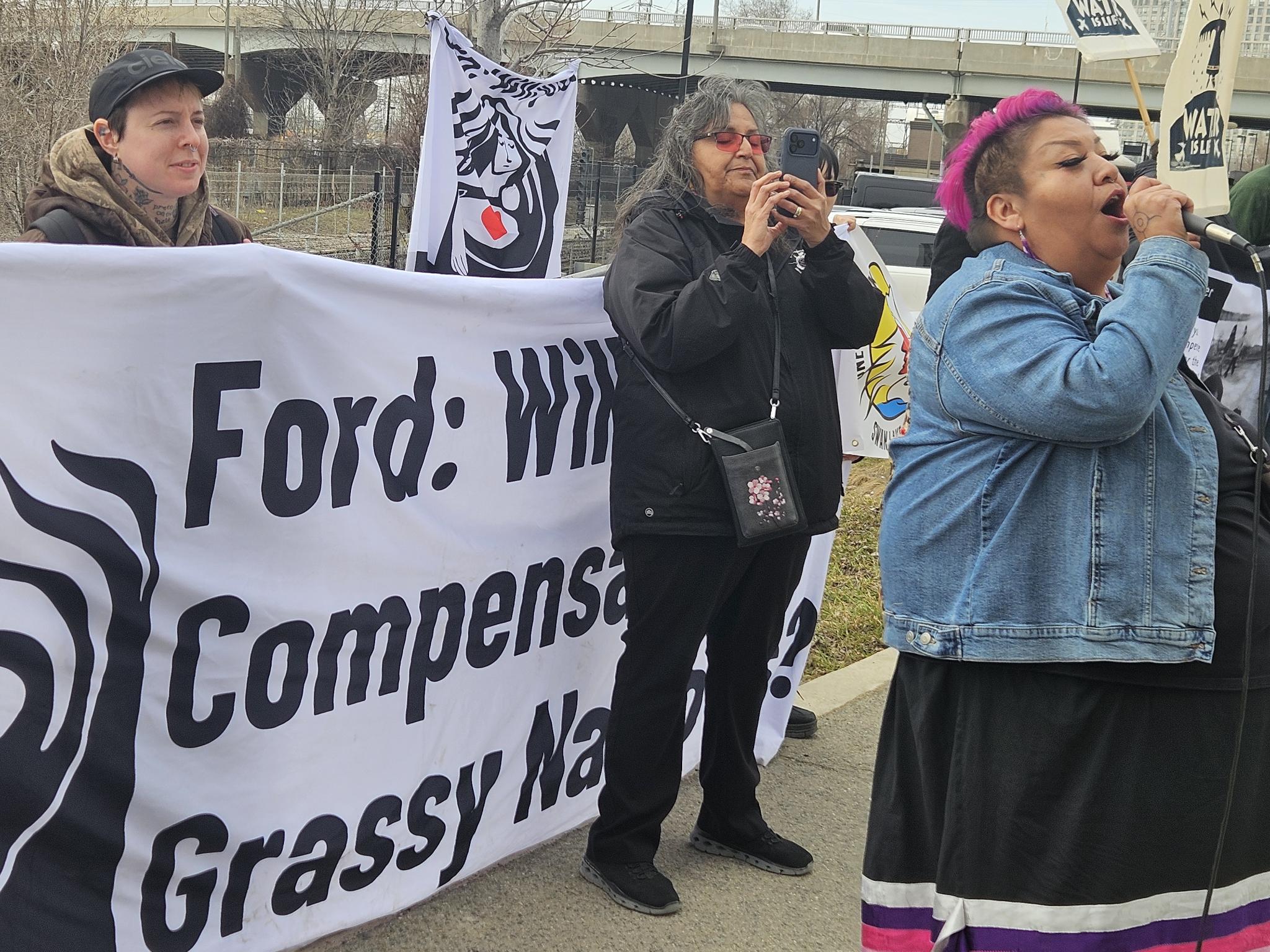
During a March 30 press conference, Prime Minister Carney made an inappropriate joke about a protestor from Grassy Narrows. In the official press conference video youth, elders, and leaders from Grassy Narrows and Wabaseemoong First Nations can be heard rallying to demand compensation for decades of mercury poisoning and the closure of Dryden pulp and paper mill. At 9:35, in response to a community member’s speech that interfered with his script, Prime Minister Carney joked, “I can outlast her, I can outlast her”.
The woman he was speaking about, Chrissy Isaacs, is a Grassy Narrows woman suffering from mercury poisoning. Studies have shown that Grassy Narrows people who are exposed to mercury are more likely to die prematurely.
The National Union of Public and General Employees (NUPGE) echoes the demand from the Chiefs of Grassy Narrows and Wabaseemoong for an apology from Prime Minister Carney, and for the Prime Minister and Premier Ford to meet with the First Nations and resolve the issues fairly.
When asked by APTN what she would like to see from the Prime Minister, Isaacs responded, “I’d like to see him come and talk to our leadership and to the people of both communities; to come see, you know, how mercury has actually affected both communities, to see our children, and for him to, you know, help bring justice to our communities by cleaning up the river, by compensating our people, and by giving our children a chance at life”.
For decades, Grassy Narrows and Wabaseemoong have lived with mercury contamination in their river system. The Dryden Paper Mill released thousands of kilograms of mercury into the community’s river system from the 1960s to 1970s and continued generating airborne mercury emissions until late 1975. In 1986 the Ontario Ministry of the Environment released an assessment of remedial measures that advised against dredging the Wabigoon River system. The provincial and federal governments instead relied on the natural process of the river cleaning itself over the course of decades. This government inaction had dire consequences.
Mercury pollution devastated the once-thriving commercial and sport fisheries and continues to impact health, livelihoods, and culture. In 2021, it was estimated that 90% of the people living in Grassy Narrows have symptoms of mercury poisoning.
In 2016, a confidential report commissioned by the current owner of the mill, Domtar Corporation, stated that the provincial government was aware that the mill site was still contaminated with mercury as early as 1990. In 2017, a research team commissioned by Grassy Narrows found that mercury levels were 130 times higher in river sediment samples taken immediately downstream of the old mill as compared to immediately upstream. Additionally, the team was able to determine that the sediments they sampled had been deposited within the last few months, indicating that an unidentified source of mercury on the mill site was actively leaking into the river.
A 2017 report from the Environmental Commissioner of Ontario states, “only now is the government finally starting to take appropriate action to meaningfully investigate the possibility of an ongoing contamination source, and to work with the affected communities to determine what remediation may be effective. Fundamental to the success of this undertaking will be the on-going, meaningful involvement of Grassy Narrows and Wabaseemoong; failing to listen to the experiences, needs and knowledge of these communities will only further delay successful remediation.”
Nearly 10 years after the report, Prime Minister Carney’s joke—regardless of whether he knew Chrissy Isaacs’ identity or not—shows that the federal government is not serious about reconciliation.
Grassy Narrows and Wabaseemoong continue to demand fair compensation for their entire communities. They are also calling for an end to ongoing industrial threats, including pulp mill effluent, that continue to prolong and compound the damage mercury poisoning has caused. Grassy Narrows and Wabaseemoong also strongly oppose plans to bury highly radioactive nuclear waste in the Wabigoon River watershed upstream from their communities.